
Trace a Reno County Address to Its Property Owner
Skip the guesswork when tracing ownership in Reno County. The Appraiser keeps the parcel roll with each owner of record. The Register of Deeds holds the recorded conveyances, including deeds that show how title passed. GIS mapping confirms the address matches the right tract before you rely on it. Use these three sources together. They give a documented answer to who owns a property. That beats a name pulled from a search result.
- Search the address in the county-linked Beacon application and save the Parcel ID, Quick Ref, legal description and Primary Owner.
- Check that situs, lot or acreage describes the intended Reno County property.
- Search the Register of Deeds system for the latest deed tied to that legal description or owner name.
- Compare the latest grantee and recording date with the appraiser's owner field.
- If the grantee is an entity, preserve its exact legal name and cross-check the Kansas business registry.
County databases do not all refresh at the same moment, so label what each source says. The full portal workflow sits on the Reno County property search page. The method here stays on the ownership answer.
Three Reno County Records Carry Different Owner Clues
"Property owner" can mean three things in Reno County records. It may be an assessed owner. It may be a deed grantee. It may be a taxpayer. Those roles usually align, but each record serves a distinct legal purpose. Whenever you write a name down, note which field it came from.
| Where ownership appears | What the source gives | Freshness check |
|---|---|---|
| Beacon parcel card | Primary Owner, mailing address, situs and parcel keys | Roll-refresh timing after a deed is not published |
| Register of Deeds index | Grantee, instrument, recording date and legal description | Use the newest relevant conveyance |
| County GIS | Spatial link between a place and parcel polygon | Save layer date and disclaimer |
| Treasurer account | Owner or taxpayer name and account status | Portal data and tax liability are separate from title |
The Reno County Treasurer search matches the current owner, the taxpayer, or both, and accepts address, CAMA, Tax ID, subdivision block and lot, or section-township-range. Treat it as corroboration rather than a substitute for the deed record.
Begin With Reno County's Primary Owner Field
The county-linked Beacon parcel application is the practical first stop. A sample card shows the Primary Owner label plus separate mailing and situs address fields. The same card carries parcel ID, Quick Ref, deed book and page, class, zoning, legal description, sales history, and building detail.
- Owner of record
- The party shown on the administrative roll at the time of its update.
- Grantee
- The person or entity receiving an interest in the recorded deed.
- Situs address
- The location assigned to the parcel or improvement.
- Mailing address
- The destination used for owner correspondence, which may be elsewhere.
- Title
- The legal ownership interest, which a simple database result does not conclusively establish.
Write down the date you viewed the card. Reno County publishes no exact schedule for how fast the owner roll refreshes once a deed records, so a just-sold parcel deserves the confirmation step.
Confirm a Reno County Owner With the Newest Deed
The Reno County Register of Deeds holds the recorded land transactions. Search the exact owner name first. Then compare legal description, parcel clues, deed type, and recording date. A deed book and page from a Beacon card bridges the appraiser roll to the recorder system. That book and page number is your link between the two systems.
Online access starts with a Tyler public-records disclaimer. It continues to a subscriber login needing credentials and a six-digit verification code. An image or account may be out of reach. Then call or visit the Register of Deeds at 125 W 1st Avenue. The county itself points researchers to that office for anything not online.
Note: Search corrective deeds and related instruments when the latest name conflicts with the parcel roll or legal description.
Identify Reno County LLC and Trust Ownership Carefully
A parcel may be vested in an LLC, corporation, trust, or estate. It may not show a person's name. Copy the grantee exactly, punctuation and all. The Kansas Secretary of State business search accepts entity name, Kansas Business ID, and resident-agent lookups. Contains and starts-with modes are available.
An entity result establishes the filing identity and resident agent. It does not prove any individual personally owns the real estate. Trust records can be thin. An estate transfer may need probate context plus a recorded fiduciary deed. Try name variants, and let the recorded vesting language control the parcel trail.
Use Reno County Legal Descriptions When Addresses Fail
Address search is weakest on rural acreage. It also struggles with newly annexed land and parcels tied to an old plat. Reno County records may turn instead on addition, block, and lot, or on section-township-range. One rural sample at High Point Road lists 150.68 acres and S07 T24 R07W. The urban card for 20 S Main cites SO MAIN ORIGINAL TOWN and lots.
Keep Parcel ID, Quick Ref, CAMA, and Treasurer Tax ID as separate fields. If an address returns no owner, try the legal description instead. Owner variants and the map also work. USPS can normalize a mailing label. ZIP geography proves nothing about ownership or city limits.
Reno County Fraud Notify Watches Names, Not Title
Reno County launched free Property Fraud Notify in March 2025 after its land-record system transition. A subscriber gets an alert whenever a document records under the chosen owner name. That notice can prompt a quick look at an unfamiliar filing.
The county stresses the service does not prevent fraud. Name spelling and entity variants matter. An alert is no ruling on validity. Bring a suspicious document number, recording date, and parcel information to the Register of Deeds. Never assume the notice itself changes ownership.
The official Reno County Property Fraud Notify page shows the signup screen in use.
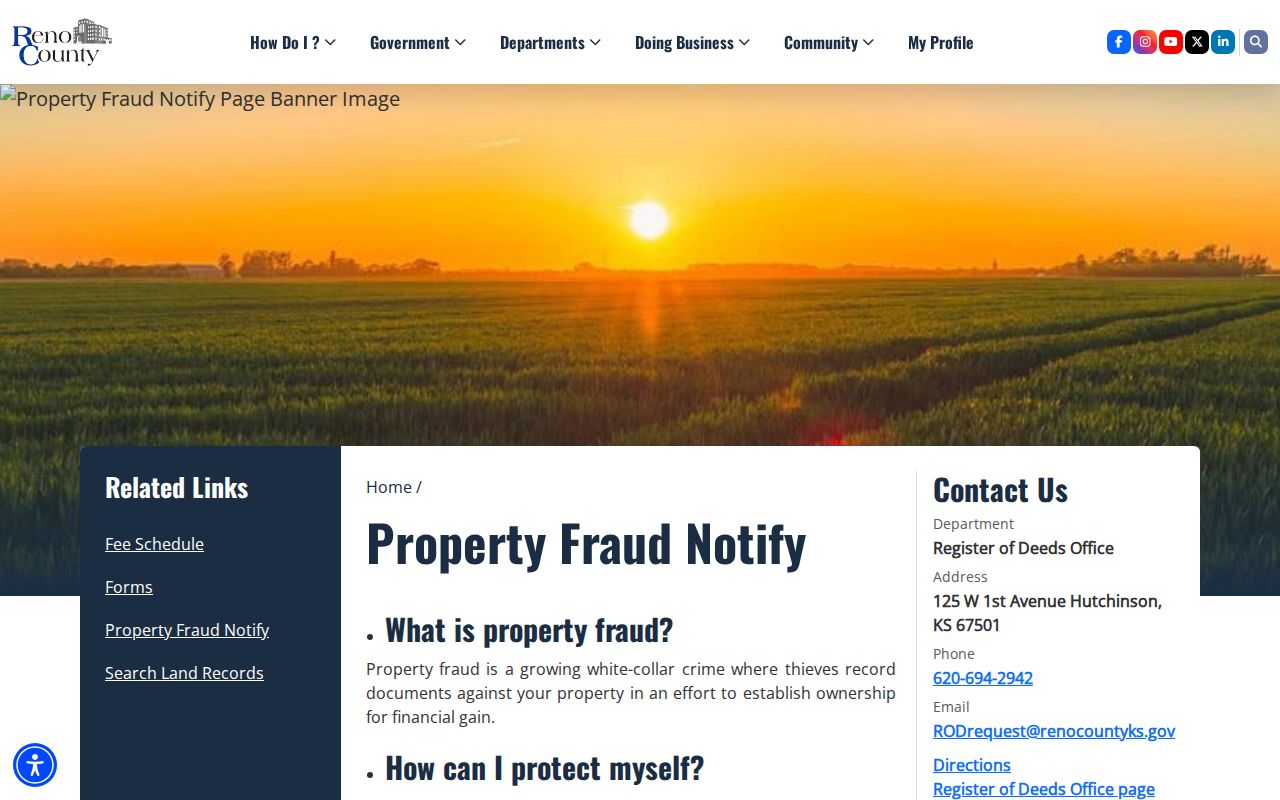
The tool ties an owner-name search to a practical monitoring step. Deed review and ownership confirmation still rest with the county records.
Limits of a Reno County Ownership Lookup
A roll name has limits. It does not show who occupies the property. It does not guarantee an unbroken chain or disclose every lien, easement, court order, or unrecorded claim. Mailing and situs addresses can differ. Kansas Safe at Home requires substitute addresses for qualifying survivors in covered government transactions. So an unavailable personal address never proves an owner or parcel is missing.
Owner name is not title proof. A Reno County roll can lag a sale, and ownership may be vested in an LLC, trust or estate. Use the newest recorded deed and professional title help when legal reliance matters.
Put owner data to lawful uses. Boundary talks, estate work, deed-fraud review, and ordinary property diligence all qualify. Never use it to watch, harass, or harm anyone. For current field-level detail, the Reno County current owner guide picks up where this page leaves off.
Sometimes no online result settles the question. That is fine. Carry the same identifiers to the offices in person. The Appraiser can hand over a property record card or comparable sheet with sales information. The Register of Deeds can reach records that never made it online. That includes material inside the historical digitization range. A focused Kansas Open Records Act request should name the parcel, the legal description, the record type, the date span, and the preferred format. It should not ask an agency to decide title.
Court records enter the picture only when the deed trail points somewhere. Foreclosure, quiet title, partition, lien enforcement, and probate are the usual triggers. Reno County provides a courthouse public computer for cases from January 1992 forward. Online Reno cases begin April 1, 2003, per the county. Keep categories straight from there. A tax account, a court case, and a recorded notice are separate events. Label each one. Then let the latest valid conveyance and any court order be read together.
Precision beats confidence in your final notation. Write "Beacon lists Primary Owner," "the Treasurer search lists taxpayer," and "the latest deed names the grantee." If their dates conflict, leave the conflict visible. That wording is more useful than forcing a tidy answer. The property records refreshed on different schedules.
Finish by building a compact ownership packet. Include the normalized address, parcel ID, Quick Ref, legal description, appraiser result, newest deed reference, any entity-search result, and the access date for each system. Rural land calls for section-township-range and acreage. On platted city land, keep addition, block, lot, and any vacation or right-of-way exception. Those keys let anyone repeat the Reno County owner search. That holds even after a portal layout or URL changes.