
Build a Reno County Deed Chain Backward
Work from the newest known conveyance, one transfer at a time. Log every detail. Each row needs the date, the names, the deed type, and the book and page or instrument number. Two repeating surnames never justify skipping a link.
| Transfer point | Grantor to grantee | Document detail to save | Next backward move |
|---|---|---|---|
| Current deed | Prior owner to current grantee | Recording date, type, legal description | Search the grantor as an earlier grantee |
| Earlier deed | Earlier grantor to that prior owner | Book/page or instrument and tract | Repeat with this grantor |
| Estate or court link | Estate, fiduciary or ordered transfer | Case reference and recorded deed | Find the decedent's acquisition deed |
| Historic volume | Indexed parties in a deed book | Volume, page, date and land description | Continue through the older index |
The Reno County Register of Deeds keeps deeds, mortgages, most liens, and plat maps for the county. Sequences, not surnames, rebuild the list of prior owners.
Walk Reno County's Grantor-Grantee Trail in Reverse
Anchor the work with the newest deed you know. On that deed, the grantee received the interest and the grantor gave it up. Search the grantor's name as a grantee in an earlier index period. The legal description must match. Only then should you accept the older deed as part of the chain.
- Start with the current parcel card and copy its deed book/page or other recorder clue.
- Locate that deed and capture the grantee, grantor, recording date, deed type and complete legal description.
- Search the grantor's exact name and variants as an earlier grantee.
- Compare lot/block, addition or section-township-range before accepting the match.
- Repeat until the online search stops, then continue through the office's older indexes and books.
- Grantor
- The party conveying the stated interest.
- Grantee
- The party receiving that interest.
- Chain of title
- The linked sequence of instruments affecting the same land.
- Reverse index
- An index organized to find grantees, useful when tracing backward.
- Warranty versus quitclaim
- A warranty deed carries covenants, while a quitclaim releases whatever claim the grantor has.
Know Reno County's Online and Offline Boundary
Reno County reports that land records from 1872 through 1990 are still being digitized. The goal is online access. Treat that as a project range. Some deeds within those years may simply be absent from the system today, and the county publishes no confirmed start year for what the subscriber system now holds.
Coverage limit. Do not assign an invented online cutoff. When a chain stops, contact the Register of Deeds for the relevant index, deed book or copy.
Online recorder access starts at the Tyler disclaimer. Subscribers then enter a username, password, and six-digit code. Walk-in and telephone service at 125 W 1st Avenue remain part of the picture.
The 2025 Reno County System Change Can Break a Search Habit
eRecording paused on February 6, 2025. The Register of Deeds then closed February 10 through 14 for software training. It reopened February 17 running Tyler Enterprise Records Management. A new URL, altered fields, a login gate, or a book-and-page reference may no longer open an image. Any of these may trace back to that migration.
Keep the old book and page. Pair it with any current instrument number. A Beacon deed reference may return no document. When that happens, ask whether its related-data link survived the migration. The recorded instrument itself is untouched; a system change only reroutes the path to it.
The official records gate sits at the Reno County Tyler records portal.
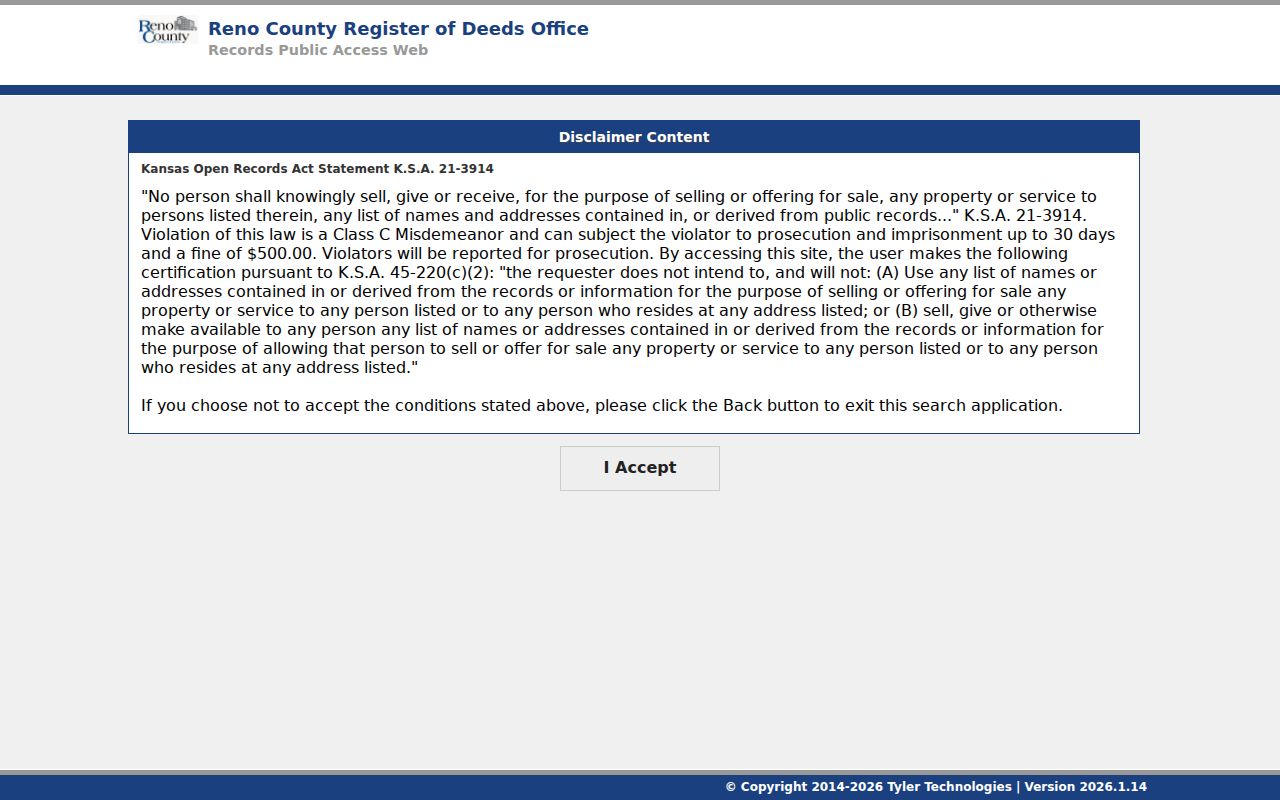
The official-records gate explains the first hurdle. Tracing past owners means accepting access terms before the recorder search opens, not landing on an open image list.
Keep Reno County Land Descriptions Attached to Every Owner
Names alone create false links, especially with families, trusts, and repeated business names. Urban parcels rest on addition, block, and lot. Rural land turns on section, township, range, acreage, and exceptions. A street name can even change while the recorded description endures.
Reno County records offer a clear contrast. One 20 S Main card cites SO MAIN ORIGINAL TOWN. It also names deed book/page 617-290. A High Point Road sample runs 150.68 acres at S07 T24 R07W. Those details separate real transfers from same-name deeds.
Note: Preserve road-right-of-way, vacated-street and easement exceptions instead of shortening a legal description to its first familiar phrase.
Use Reno County Plats to Recover Old Place Names
A recorded plat can tie today's parcel to a vanished subdivision, block, street, or dedication. College Hill Addition shows how in Reno County. A county legal description covers Block 13 plus the north ten feet of 20th Avenue. That strip was vacated by Hutchinson Ordinance 1077. Every later deed must be read against it.
The Kansas Historical Society's 1902 Reno County plat-book record adds township, road, and historical ownership context. A printed name proves no conveyance. It points only toward the right deed-book territory. The recorded deed itself completes the chain.
Explain Reno County Chain Gaps With Probate and Court Records
A deceased owner sometimes vanishes from the deed chain. The transfer may have run through an executor's, administrator's, or other fiduciary deed. The recorded deed still matters most. A Reno County District Court probate file explains the authority and distribution behind it. Court records sit on a courthouse public computer for January 1992 forward. The county says online Reno cases begin April 1, 2003.
Use a case number for copies. An order, petition, or inventory adds context but never replaces the recorded conveyance itself. Vital records stay confidential under Kansas rules with eligibility limits. Estate research must use lawful channels.
Let Reno County Directories Add History, Not Title
Old directories and newspapers can surface leads when former owners matter to a property's story. A name variant, an occupant, a business, or an estate lead may turn up. Reno County holdings include local directory entries from 1887-88, Hutchinson directories for 1918 and 1935, newspaper microfilm, and a county cemetery publication covering 1865-1978.
The local Reno County directory index and the Kansas Historical Society collections serve as finding aids. They name people and places. They do not prove ownership. Carry any name back to the recorder index. Then insist that the legal description and transfer document line up before treating it as part of the chain of title.
How Far Reno County Former-Owner Research Can Reach
Reno County dates to 1867. Its digitization project points to land records starting in 1872. Those dates set a historical frame. They do not promise an unbroken online ownership chain reaching back that far. Gaps can come from missing images. Shifting legal descriptions and land origins that predate the county itself create others. Filling those gaps may take the recorder, the Kansas Historical Society catalog, plats, court files, or professional title research.
Use the chain lawfully. Former-owner research supports property history, estate work and title diligence. Never use it to track, harass or harm a living person.
One deed index entry never closes the book. Later releases, assignments, corrections, and court orders can all reshape a transfer. This can happen after it was recorded. For the mechanics of a single instrument, see the Reno County deed records guide. It walks through copies and details. Label each step of a past-owner timeline with its source. Do that until every transition is verified. When records are not online, send the Register of Deeds a focused request. Include the tract, the approximate year, and the parties. Add the document type and any known book and page. The office page posts telephone and email contact details. Kansas Open Records Act procedures can support an inspection or copy request. Authorized copy and staff costs can apply, though, and exemptions may limit access. Never turn a directory occupant or a tax-roll name into a quiet deed-chain link. Record it as a lead, with its source and year attached. Then test it against the grantor and grantee indexes. Cemetery surnames and newspaper notices deserve the same care. They can surface an estate, a street variant, or a family connection. Still, only a recorded transfer can bridge one owner to the next.